The romance of global e‑commerce usually ends at the browser tab, but the real battle starts where the Wi‑Fi weakens and the oil hits the wok.
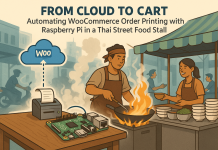
Imagine web orders landing on a polished Linux stack in London while, thousands of miles away, a vendor in Bangkok is juggling ladles, banknotes, and a buzzing phone screen in 90% humidity. That disconnect between pristine cloud infrastructure and the raw reality of a street kitchen is exactly where most digital systems fail. The challenge is not accepting payments online; it’s turning those transactions into something the cook can trust and act on instantly, without swiping or tapping anything mid-rush.
Instead of relying on fragile mobile apps or manual refresh rituals, the smarter approach is to treat the kitchen like an edge-computing node.
A Raspberry Pi, hardened and tucked near the grill, becomes a tiny gateway between WooCommerce events and a thermal printer that speaks the cook’s language: paper. By exposing an Nginx endpoint on the Pi and wiring it to receive WooCommerce webhooks, every confirmed order is pushed directly into the stall’s local network. That webhook payload is parsed, formatted, and fired at CUPS, which drives the thermal printer to spit out a clear, kitchen-friendly ticket, independent of whoever is holding the restaurant’s only smartphone.
Making this flow reliable across continents requires more than just clever routing; it demands thoughtful system engineering.
Rather than poking permanent holes in a café-grade router, a persistent SSH tunnel from the Pi to the London server can establish a reverse channel, letting the server deliver webhooks securely to an otherwise hidden device. Nginx handles the local HTTP traffic, CUPS manages the printer queue, and lightweight scripts glue everything together. The result is a tightly controlled pipeline: transaction in the cloud, packet across the wire, print job on the counter, all in a span that feels instant to both customer and cook.
But the elegance of the architecture is useless if the hardware dies in a cloud of steam.
This is where DevOps thinking meets industrial pragmatism. The Pi needs a sealed, heat-resistant enclosure, filtered ventilation, and power protection robust enough to shrug off brownouts. The operating system should be tuned to minimize writes to the SD card, use journaling and watchdog services, and recover quickly after abrupt shutdowns. Measuring latency from payment confirmation to printed ticket is not a vanity metric; in a lunch rush, shaving seconds off that pipeline turns confusion into flow. When the printout lands on the counter before the browser shows a thank-you screen, the system starts to feel like magic, even though it’s just disciplined engineering.
What emerges is more than a clever hack for one food stall; it’s a pattern for digital sovereignty at the edge.
Any merchant, anywhere, can own their automation stack end to end, blending open-source tools, low-cost hardware, and robust DevOps practices to erase the gap between cloud decisions and physical work. In that sense, the Thai street kitchen becomes a proving ground for a broader idea: high-end orchestration doesn’t belong only in data centers. It can — and should — live where the action is, whether that’s under neon lights, beside sizzling woks, or in any place where a printed ticket is still the most reliable interface between code and human craft.